


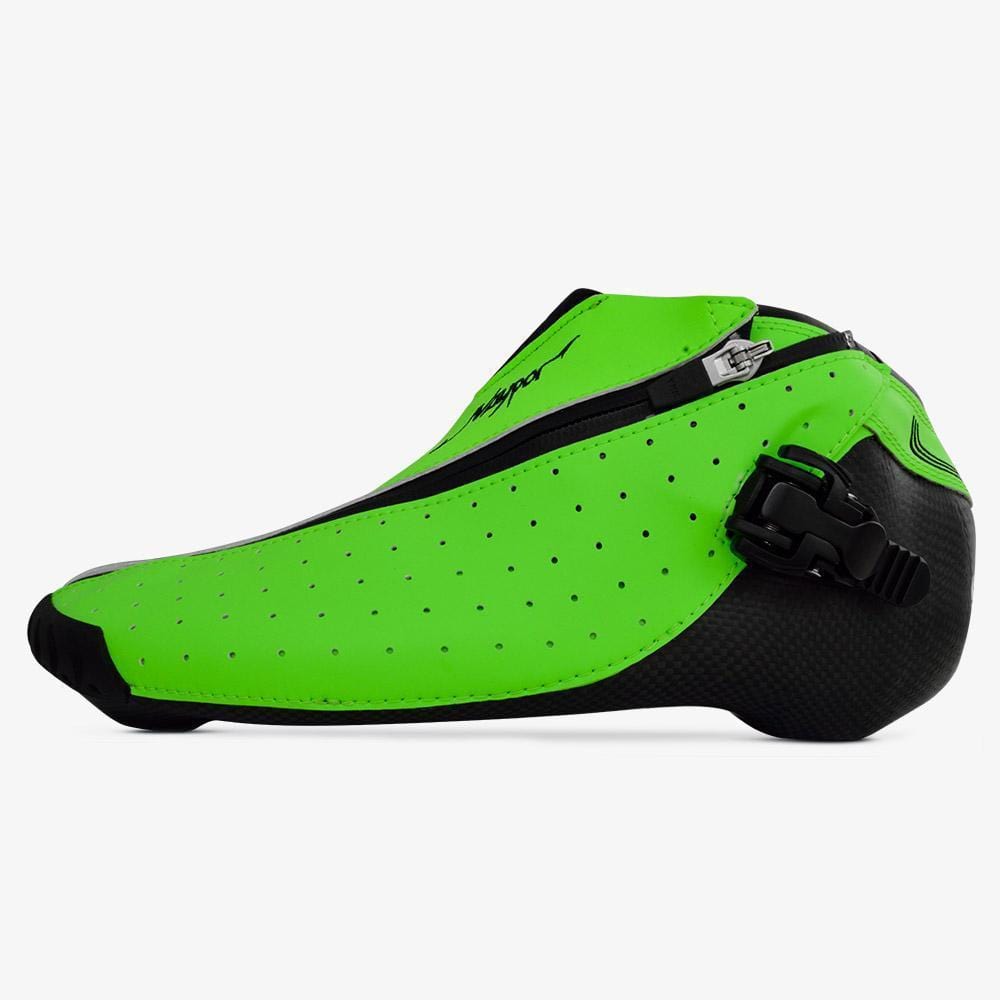
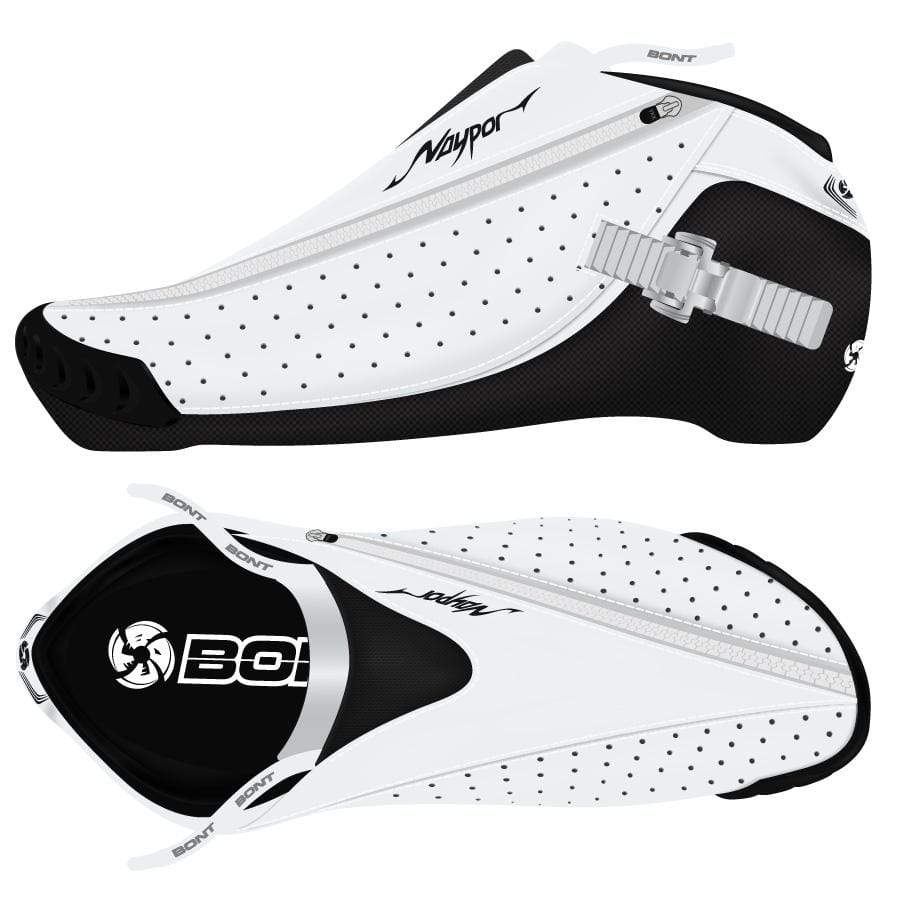
The Vaypor has a huge number of options, far too many for this shopping cart to manage so we created the MyBonts site to guide you through all of the options so that it is tailor-made to your foot. MyBonts is used for ordering semi-custom and custom boot options.
Here are the options you can select:
Boot colors, boot materials, stitching color, individual boot size (left and right foot in different sizes), room for orthotics, lace color options, room for growth, buckle options, ankle width, arch height, boot height, toe box, stiff boot sides, boot stiffness, heat moldability, boot padding, boot liner, and full custom. We will build your Vaypor the way you want it.
The semi-custom Vaypor will take between 6-8 weeks to make depending on the time of year. June - December is the fastest production time.
Check out our Instagram account to see some of the best custom Vaypor boots designed from skaters around the world.
Features
- Base: 100% carbon with uni directional carbon and matte finish
- Outer skin: Durolite
- Liner: Suede-like
- Pitch: 12mm
- Air vents: Toe and tongue
- Innersole: EVA thermo-moldable
- Heat moldable: Fully heat moldable base utilizing epoxy thermoset resin
- Padding: Medium density memory foam
- Protection: Front TPU bumper
- Vegan: Yes
Please note the colors displayed on your screen are a close representation of what your product will look like. We have tried to make this representation as close as possible but the finished product may look slightly different from what you see on the screen. The texture of the material may also differ.
Carbon Fiber
Carbon fiber (or carbon fibre, depending on US or UK spelling) is an advanced composite material known for its exceptional strength-to-weight ratio. It is as strong as steel while weighing only a fraction as much.
Carbon fiber is made from bonded carbon atoms aligned along the length of each fiber. Thousands of these fibers are twisted into a yarn, which is then woven into fabric. This fabric forms the carbon sheets used in high-performance products.
Bont has been producing carbon-based boots since 1989. We source our carbon exclusively from Toray in Japan, the world leader in carbon fiber manufacturing.

Types of Carbon We Use
3K PLAIN
A tightly woven carbon commonly used in the aircraft industry and throughout Bont boots. Strong, reliable, and ideal for structural applications.

UNIDIRECTIONAL
Extremely stiff, lightweight carbon with fibers running in a single direction. This lets us place the carbon exactly where strength and support are needed. Used in our highest-performance boots, such as the Vaypor.

12K PLAIN
A larger weave that is more economical but not as strong as 3K. It reduces cost while maintaining adequate performance in less demanding applications.
INDUSTRY MISREPRESENTATION
Modern composites can be confusing, and not every product marketed as “carbon” contains true carbon fiber construction. Here are common examples of misleading terminology in the industry:
Single-Layer Carbon
Some boots have a plastic, nylon or fiberglass base covered with only one cosmetic layer of carbon. Although they can legally say “carbon base,” the structure underneath is not full carbon.
Unidirectional Carbon (Misused)
Some brands add carbon particles into plastic and call it “unidirectional carbon.” True UD carbon refers to continuous fibers all running in the same direction, not carbon-filled plastic.
Silver Fiberglass
A plastic base with carbon particles is often wrapped with silver fiberglass, then marketed as “carbon fiber.” Real carbon fiber fabric is always black.
100% Composite
A vague term that can mean almost anything. In most cases, it refers to a nylon–fiberglass composite, not a full carbon construction.
Monocoque (Misused)
A true monocoque boot has carbon laminated directly onto the liner, forming a one-piece shell. Some brands use the term incorrectly for shells with an integrated heel cup.
In Summary
Carbon terminology can be misused, so it helps to understand what you are buying. Bont uses genuine carbon fiber from Toray and builds boots with transparent, proven construction methods. Knowing the differences ensures you get the performance, strength, and value you expect from a true carbon boot.
Manufacturing Process
Bont is one of the few skate brands that still handcrafts boots using an inside-out manufacturing method. This approach is far more skill-intensive and time-consuming than mainstream production, but it allows us to create boots with the performance, strength and responsiveness skaters expect. While it increases production costs, it delivers a lighter and more precise final product.
We continually refine our processes to maintain the highest quality. For example, traditional vacuum curing for carbon has been replaced with pressure wrapping, which applies four atmospheres of pressure instead of one. This produces a more consistent and durable carbon layup.
Inze Bont’s engineering innovations have helped optimize our production line so we can build handmade monocoque boots efficiently without compromising craftsmanship.
Our manufacturing methods reflect our performance philosophy: lighter, stronger and faster.
For more detail on individual components of our construction, explore the technical dropdowns on this page, including Last Design, Footbed, Liner, Anti-Stretch, Carbon Fiber, Upper and more.